Research

Publications

Home Foreclosure Discounts in Auctions Without Reserve Prices

Real Estate Economics, 2026

Abstract
This paper estimates foreclosure discounts in Cape Town, South Africa, where, until 2019, foreclosure auctions occurred without reserve prices. Using newly constructed data linking sheriff auction notices to the universe of property transactions, rich property characteristics, and municipal service request records, I document large foreclosure discounts that vary by empirical approach. In a cost-adjusted hedonic framework, properties sold at foreclosure auction transact at a discount of 14.5 per cent relative to comparable non-foreclosed sales; repeat-sales estimates yield substantially larger discounts of 30.2 per cent. These estimates bracket the plausible range of the true discount: the hedonic provides a conservative lower bound after netting out buyer-incurred transaction costs, while the repeat-sales provides an upper bound that additionally captures time-varying deterioration not fully observed in cross-sectional data. The magnitudes documented here are large relative to settings with reserve prices, reflecting an institutional environment where the absence of a reserve price leaves auction outcomes effectively unbounded on the downside. The implications are especially severe in South Africa’s recourse mortgage system: foreclosed borrowers who lose their homes at auction may also remain liable for any balance between the sale price and the outstanding mortgage, compounding the household-level costs of foreclosure.
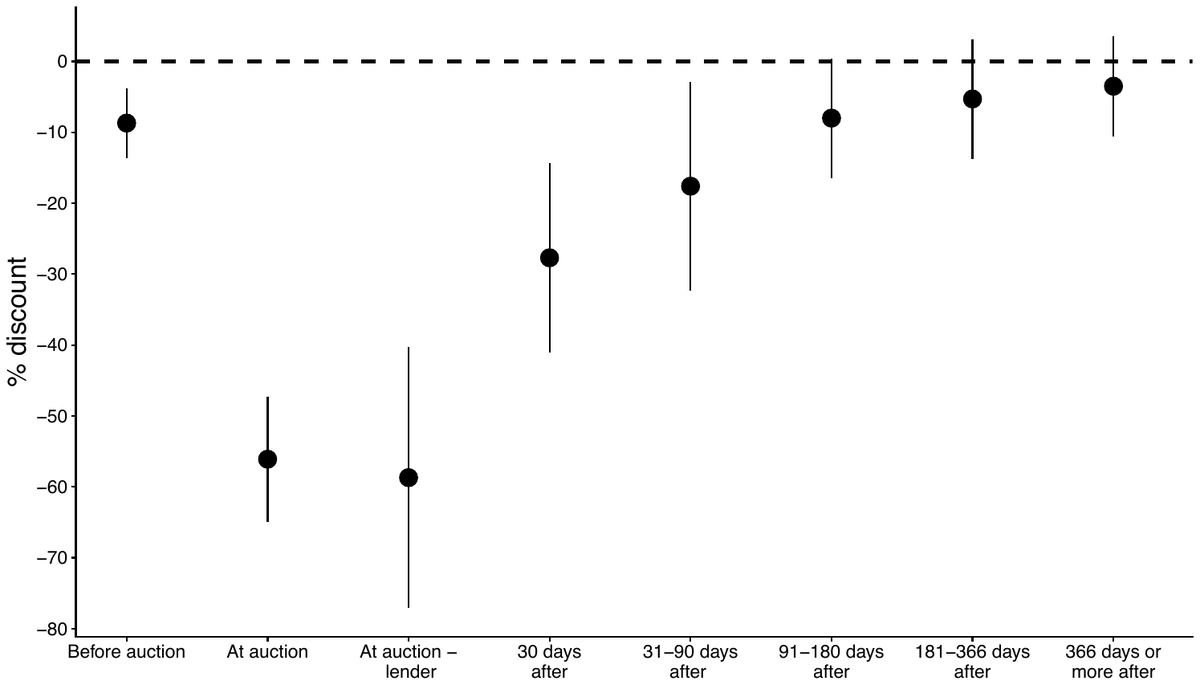
Estimated foreclosure discounts across time
Key figure. Estimated foreclosure discounts across time

Social Learning in a Network Model of COVID-19

with Gideon du Rand, Co-Pierre Georg, Tina Koziol and Joeri Schasfoort

Journal of Economic Behavior & Organization, 213, 2023, 271–304

Abstract
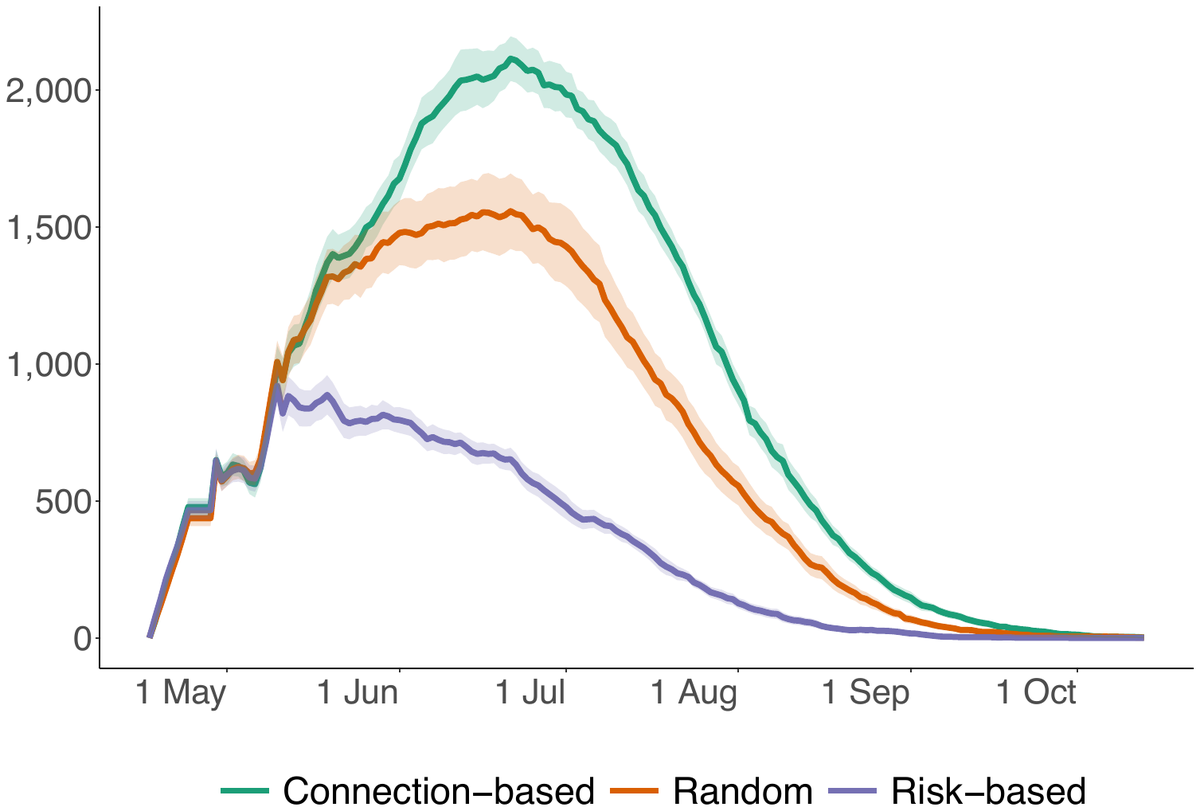
This paper studies the effects of social learning on the transmission of Covid-19 in a network model. We calibrate our model to detailed data for Cape Town, South Africa and show that the inclusion of social learning improves the prediction of excess fatalities, reducing the best-fit squared difference from 20.06 to 11.28. The inclusion of social learning both flattens and shortens the curves for infections, hospitalizations, and excess fatalities. This result is qualitatively different from flattening the curve by reducing transmission probability through non-pharmaceutical interventions. While social learning reduces infections, this alone is not sufficient to curb the spread of the virus because learning is slower than the disease spreads. We use our model to study the efficacy of different vaccination strategies and find that a risk-based vaccination strategy—vaccinating vulnerable groups first—leads to a 50% reduction in fatalities and 5% increase in total infections compared to a random order benchmark. By contrast, using a contact-based vaccination strategy reduces infections by 9% but results in 64% more fatalities relative to the benchmark.
Efficacy of different vaccination strategies
Key figure. Efficacy of different vaccination strategies

Working papers

Diffuse Bunching with Frictions: Theory and Estimation

with Santosh Anagol, Ben Lockwood and Tarun Ramadorai

Reject and Resubmit, The Review of Economic Studies

Abstract
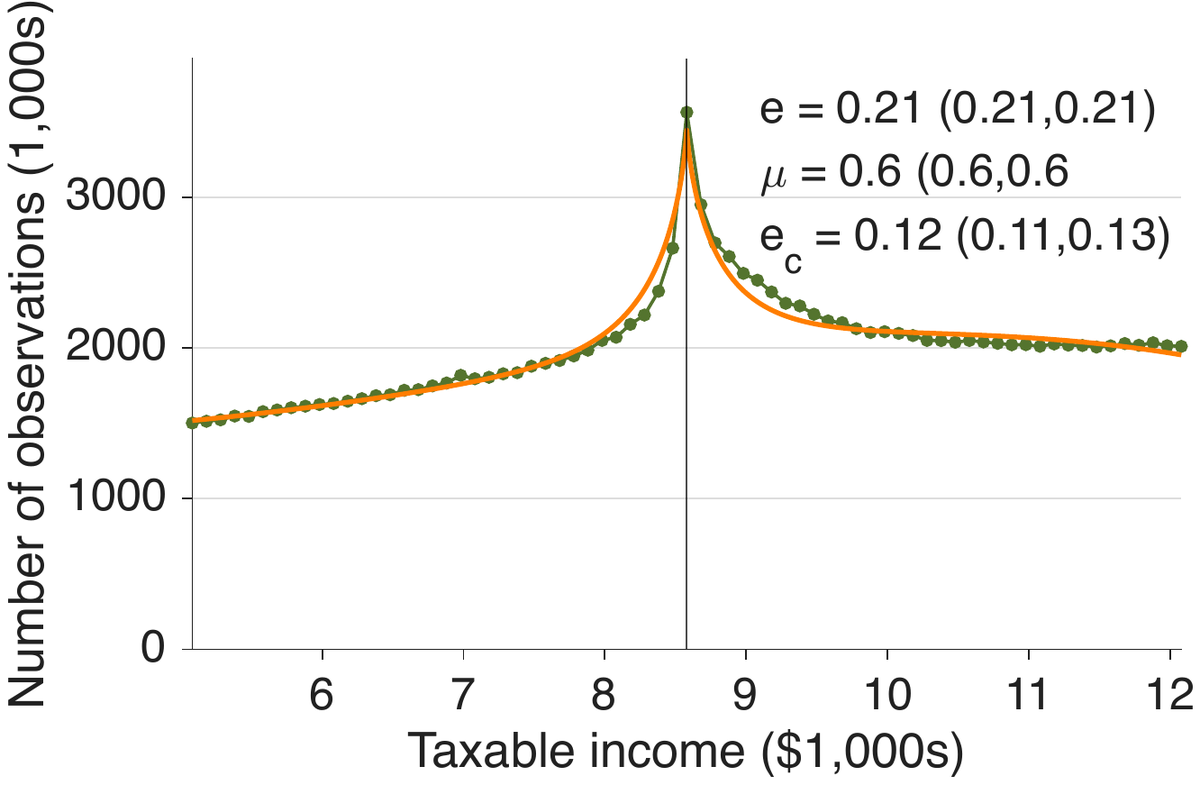
We incorporate a general model of frictions into the bunching-based elasticity estimator. The new estimator replaces bunching-window bounds with a “lumpiness parameter” and uses fewer parameters than the conventional approach while delivering additional economically-interpretable quantities such as the size of frictions and unobserved adjustment costs. The model matches rich observed bunching patterns such as sharp-peaked diffuse bunching around tax kinks and depressed density in notch-adjacent dominated regions. We apply the estimator to canonical settings including the U.S. EITC kink, and to administrative tax data from South Africa, where we uncover novel insights on unobserved VAT compliance costs and kink misperceptions.
Bunching at the EITC kink
Key figure. Bunching at the EITC kink

Work in progress

When the Lights Stay On: Electricity Reliability and House Prices

with Joshua Budlender

Draft available on request

No Room(s) for Locals? Airbnb and the Housing Market in Cape Town

with Kristoff Potgieter

Draft available on request

Who Owns the City? Foreign Ownership of Real Estate

Resting papers

The Cape of Good Homes: Exchange Rate Depreciations, Foreign Demand and House Prices

May 2020

Abstract
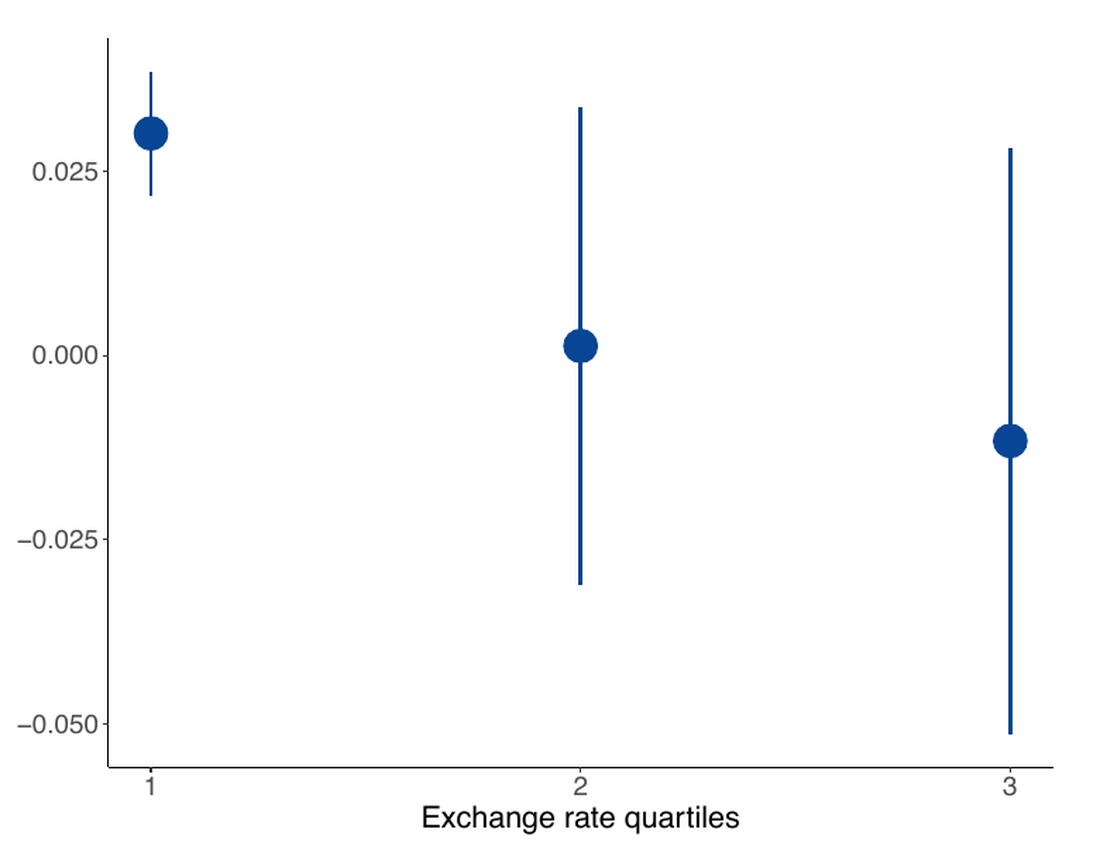
Emerging markets are characterized by frequent periods of large and unexpected exchange rate depreciations. These events create opportunities for foreign investors to purchase domestic assets at a discount, especially if these assets have sticky prices. We show this to be the case in the housing market in Cape Town, South Africa. Using property transaction data, I find that foreign non-residents buy more properties following large exchange rate depreciations—in the lower quartile of month-on-month changes. I find no evidence of a similar effect for other buyers, suggestive of strong exchange rate-related motives. Using these depreciations as demand shocks to foreign non-resident buyers, I find that this increased demand leads to an increase in house prices of 3.39%. I find that foreign non-resident buyers pay 10.42% more than other buyers for otherwise identical properties and that this tendency to pay a premium accounts for around 27% of the observed causal impact of foreign demand on house prices.
Exchange rate effects on house price spreads
Key figure. Exchange rate effects on house price spreads

Policy writing

Housing Affordability in Cape Town: Evidence and Policy Recommendations

ERSA Policy Paper 64, 2026

Home Foreclosure Discounts in Auctions Without Reserve Prices: Evidence from Cape Town

ERSA Policy Brief 214, 2025

The distributional impact of liquidity regulation on mortgage lending

South African Reserve Bank Financial Stability Topical Briefing, 2025

The consumer credit landscape in South Africa

with Esti Kemp, South African Reserve Bank Financial Stability Topical Briefing, 2017

Understanding Housing Markets: using municipal data

with the Centre for Affordable Housing Finance in Africa, World Bank Report, 2016